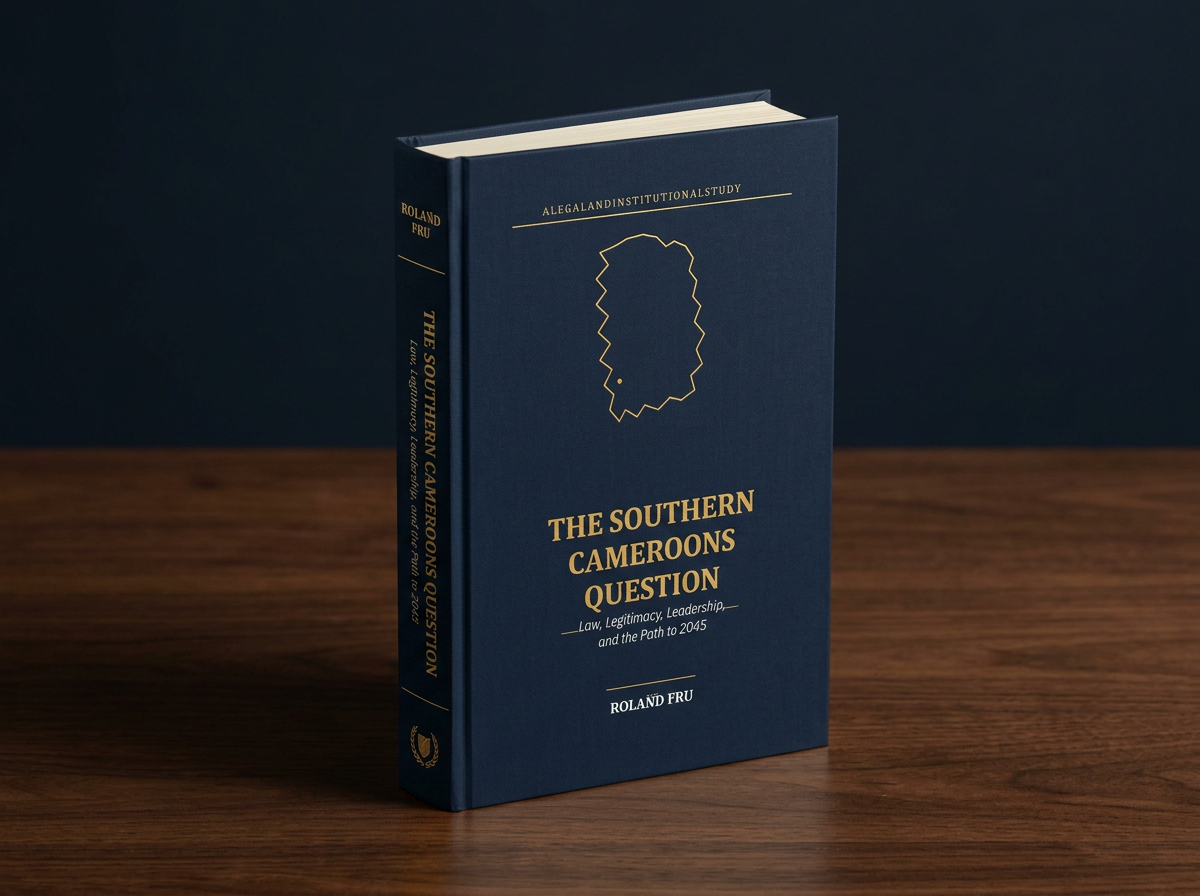
A Legal and Institutional Study
The Southern Cameroons Question
Law, Legitimacy, Leadership, and the Path to 2045
By Roland Fru
This book examines one of the most important unresolved legal questions in the history of the Southern Cameroons: by what legal instrument did the territory complete its transition from United Nations Trusteeship into its constitutional relationship with La République du Cameroun?
237
Pages
60+
Years of Unresolved Questions
UN
Primary-Source Records
🌍
Available Worldwide on Amazon
Why This Book
Why this book matters
For decades, discussions concerning the Southern Cameroons have often centered on politics, personalities, events, and competing narratives.
This book takes a different approach.
It begins with documents, legal foundations, institutional analysis, and historical records. Rather than starting with conclusions, it starts with evidence.
The goal is not simply to argue a position but to examine one of the most important unresolved legal questions in the history of the Southern Cameroons through the lens of law, governance, leadership, and institution building.
The Central Questions
Three questions. One answer required.
One
What legal instrument gave legitimacy to the present relationship?
Two
If such an instrument exists, where is it?
Three
If it cannot be identified, what process should follow?
Inside the Book
What readers will learn
International Law
The legal framework that governed Trust Territory transitions and the doctrines still binding today.
United Nations Trusteeship System
How the Trusteeship Council supervised termination — and what verifiable acts the Charter required.
Constitutional Development
The practice of constitution-making, ratification, and the difference between an arrangement and a settlement.
Leadership and Institution Building
Why durable nation-building rests on legitimate institutions, not personalities.
For Readers
Who should read this book
Southern Cameroonians
Seeking legal clarity grounded in primary documents.
Researchers & Historians
Working on decolonization, trusteeship, and African history.
Lawyers & Constitutional Scholars
Studying treaties, ratification, and constitutional legitimacy.
Students of International Law
Tracing the UN Charter, Trusteeship system, and the ICJ record.
Policymakers & Civic Leaders
Building institutions on legitimate legal foundations.
Anyone Interested in Self-Determination
Decolonization, sovereignty, and post-colonial transitions.
Historical Arc
Six centuries. One unresolved question.
1472
Portuguese navigators reach the coast of present-day Cameroon.
1916
German Kamerun is partitioned between Britain and France after the First World War.
1954
British Southern Cameroons obtains a distinct quasi-federal status within Nigeria.
1961
UNGA Resolution 1608 terminates the Trusteeship; the legal instrument question begins.
1972
Unilateral abrogation of the federal structure restructures the state.
1984
Renaming of the state by constitutional amendment.
2016
The Anglophone crisis brings the unresolved question back to international attention.
2025
Publication of The Southern Cameroons Question — a legal and institutional study.
Research Foundation
Built on the institutional record
This is not opinion journalism. Every claim is anchored in verifiable, primary-source material.
United Nations Records
General Assembly resolutions, debates, and official documents.
Trusteeship Documents
Trusteeship Council records and termination proceedings.
Constitutional Materials
Ratification practice and constitution-making evidence.
International Law Sources
Charter provisions, treaties, and ICJ jurisprudence.
The Record
Key documents examined
Primary-source instruments from the United Nations and international law that anchor the inquiry.
UNGA Resolution 1608
1961 — Termination of the Trusteeship
UNGA Resolution 1541
Principles governing transmission of information
Trusteeship Agreement
British Cameroons under UK administration
UN Document T/1526
Trusteeship Council record
UN Charter, Article 76
Basic objectives of the trusteeship system
UN Charter, Article 102
Registration of treaties
Northern Cameroons Case
ICJ Reports 1963 — Cameroon v. United Kingdom
Publication Asset
Front cover & full wraparound
Click any image to view at full resolution.

About the Author
Roland Fru
Researcher · Writer · Founder, Southern Cameroons Legal Clarity Framework
Roland Fru is a researcher, writer, leadership strategist, and institutional-development advocate whose work focuses on legal clarity, leadership development, civic education, and long-term nation-building.
His research examines decolonization, trusteeship termination, constitutional legitimacy, leadership systems, institutional development, and Vision 2045 frameworks.
Mission Commitment
Supporting Research and Institution Building
The Southern Cameroons Question is more than a publication. It is part of a broader effort to encourage legal clarity, institutional thinking, leadership development, and evidence-based civic education.
A portion of proceeds from book sales is allocated toward:
- Legal clarity research and documentation
- Institutional-development and capacity-building initiatives
- Leadership and civic education programs
- Archival and documentary preservation
- Strategic outreach, engagement, and diplomatic efforts that advance informed discussion around legal clarity
By purchasing this book, readers help support ongoing research, education, and institution-building efforts designed to promote long-term understanding, leadership, and responsible civic development.
10% of net proceeds supports this mission.
Preview
Read a sample chapter
Download Chapter One directly — no signup, no email collection, and no form required.
Read a Sample ChapterVision 2045
Legal clarity is a foundation, not a destination.
Beyond it lies the patient work of leadership development, human capital formation, economic transformation, institution building, and long-term national development.
Support Legal Clarity
A portion of proceeds generated through this publication supports civic education, legal clarity research, leadership development, and institutional capacity-building initiatives.
Learn More About SCDFForthcoming
What readers are saying
Endorsements from legal scholars, historians, and researchers will appear here as reviews are received.
Reserved for forthcoming endorsement from a legal scholar, historian, or constitutional researcher.
— Reviewer pending
Reserved for forthcoming endorsement from a legal scholar, historian, or constitutional researcher.
— Reviewer pending
Reserved for forthcoming endorsement from a legal scholar, historian, or constitutional researcher.
— Reviewer pending
FAQ
Frequently asked questions
Audio Version
The Southern Cameroons Question — Audio Version
The audio version of the book will be available here when the launch begins.
Join the waitlist to receive the Amazon link, audio release notice, and SCDF launch reminder.